Permit rates for 2013-2014 are set and have been approved by the UNC Charlotte Board of Trustees. First, the unpleasant news: permit prices will rise again this year, by about 8%
One bright spot for non-resident students with compressed Monday/Wednesday or Tuesday/Thursday schedules: new Commuter permit options have been added in response to their requests. Class schedules have created enough of these students to justify offering Monday/Wednesday and Tuesday/Thursday permits for purchase by the semester.

What’s new for 2013-2014
M/W and T/Th one semester permits
As mentioned above, these permits are an economical option for Commuters who are only required to be on campus for Monday/Wednesday or Tuesday/Thursday classes. They are valid for one semester, only on the days specified. On all other weekdays, these Commuters must pay to park in Visitor Decks or at meters, even after 6:00 pm.
South Village Deck
Freshmen assigned to highrise residence halls will no longer have to park across campus in North Deck. The new South Village Deck will have over 1,200 spaces. While construction of the South Village Dining Hall will be ongoing for another year, insufficient parking will no longer be a problem.
South Village Deck highlights:
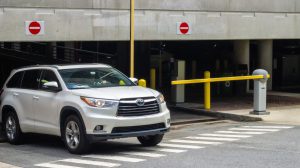
- Stained white ceiling and bright induction lighting for safety and visibility;
- RFID controlled gated access
- Convenient Visitor parking in the deck with “pay-on-foot” station.
What remains the same
- All parking permits are hang tags with an encoded Radio Frequency ID (RFID) chip to open appropriate gates for your permit type
- Hang tags must be hung from the rear view mirror or displayed on the windshield on the driver’s side by using a PaTS approved display pouch
- Permit types have specific access
- Faculty and Staff who have purchased premium lot access will have the RFID on their hang tag programmed to open gates.
- RFIDs allow Commuter students to access CRI deck. Resident Students will be allowed to park in the CRI deck after 6:00 PM.
Multi-vehicle registration
To register more than one vehicle to a hang tag, the cost is $15, unchanged from last year. You may register as many vehicles as you own to any one tag. (As defined in the campus parking ordinances “No faculty, staff member, or student may register a vehicle not owned by that individual, his/her spouse, a parent or guardian, or assigned to the individual by his/her employer.”)
Discount remote parking options in Lot 6A and Lot 27
Lower-priced permit options for Faculty/Staff and Commuters will continue to include:
- Lot 6A (at the corner of Cameron and John Kirk, served by the Rt. 50 Red Line shuttle)
- Lot 27 (on Toby Creek, near Harris Alumni Center), a walk-in lot
Discount remote parking at Starlight Cinema (North Tryon Street) may not be offered for 2013-2014. However, Parking and Transportation Services is working with the Charlotte Area Transit System and management companies from surrounding apartment complexes in an effort to make this option possible. A final decision will be made and announced on the PaTS website before 2013-2014 permits become available for online purchase.
Carpools
Carpools need to be arranged with Parking and Transportation Services so that multi-vehicle hang tag listing all the carpool vehicles and their owners may be registered.
Each carpool will be allowed up to 10 free daily temporary permits per academic year. That way, on days when you need to drive your own car and not be a part of the carpool, you may legally park. Daily temporary passes can be picked up at the PaTS office in advance of the day needed, or you may park in front of the PaTS Office for long enough to procure that day’s permit.
FAQs about permit prices
Why does it cost so much to park my car on campus?
Campus parking has to be self-supporting. This is because:
- State funding is not used to pay for parking facilities;
- Tuition dollars do not supplement parking;
- Collected citation fines cannot supplement construction or maintenance of parking facilities.
PaTS Director Gary Caton explains, “Replacing surface parking with parking decks increases cost of operation and debt service. The sale of parking permits and Visitor parking fees are the only source of revenue, because, contrary to popular belief, citation fines do not generate income for Parking and Transportation Services.”
Business Services (of which PaTS is a division) has endeavored to keep prices as low as the financial model will allow, while adding new decks and parking control technology that will benefit campus now and in the future. The principal factor that determines permit pricing is the cost of new deck construction and replacing surface lots with decks. It’s expensive to design, construct and maintain new parking decks needed to accommodate enrollment and demand. When surface lots must make way for new buildings and residence halls, those spaces must be replaced with decks.
What do Permit fees pay for?
Almost all of it goes toward design and construction new parking decks, maintenance and debt service (paying back construction bonds) of existing decks/lots, with a small percentage going toward traffic control staffing and support of the CATS Campus Shuttle.
What about fines collected from citations? Where does that money go?
There are State statutes governing this (GS 115C-457.1-3 - page 305) determining that civil fines (as well as penalties and forfeitures) less the cost of collection have to be remitted to the State; then the State allocates the money to local public schools.
The cost of collection is capped at 20%, regardless of what it may actually cost the agency or municipality to collect the fines. Enforcement and collection costs the University more than the amount we’re permitted to keep. Business Services remits the 80% of all fines collected to the Office of State Budget and Management (OSBM) monthly.
PaTS and the University do not gain financial benefit from citation fines. In fact,
- it costs us money to enforce permits and deter illegal parking;
- expect to see more lots and decks being controlled by gate systems; they require less citation enforcement;
- more gates and less citation enforcement benefits campus as whole because automated parking control lowers cost.
One last thought from the director of Parking and Transportation Services
“I fully understand the financial impact and feelings of concern that arise when parking rates increase," says Caton. "But here’s the math: As enrollment has risen, parking has had to grow from 10,499 spaces and six parking decks in 2006 to 14,694 spaces with ten parking decks by July 2013. That’s 40% more parking. The corollary is that permit rates have had to increase as well. During the same period the price rose from $265 to $450 which is 42%; almost the same amount.
“I know that this explanation does little to lessen the displeasure that is inevitably felt when we’re told permits will cost us even more, but I do hope it offers some understanding of ‘why’.”
For questions about permits and parking for 2013-2014, contact Parking and Transportation Services. Write pats@uncc.edu, call 704‑687‑0161, or start up a conversation on Twitter, @unccparking.
Look for additional parking updates that will be posted over the summer to Auxiliary Service's news page and linked on the Auxiliary Services at UNC Charlotte Facebook page.

Dining Hours for Wednesday May 1 - Sunday May 12.


Permits for Spring semester